




hadihz.me
This very website you are visiting right now, focusing purely on aesthetic, visuals, and performance, with a minimal JavaScript footprint, built with Astro 7, backed by Strapi 5!
Architecture Overview
This is the site you are reading: a four-language portfolio (English, Arabic, French and German, right to left in Arabic) built with Astro and fed by a Strapi CMS. It is meant to look good and load fast, so every page is prerendered HTML served from a CDN, with JavaScript only where an interaction needs it.
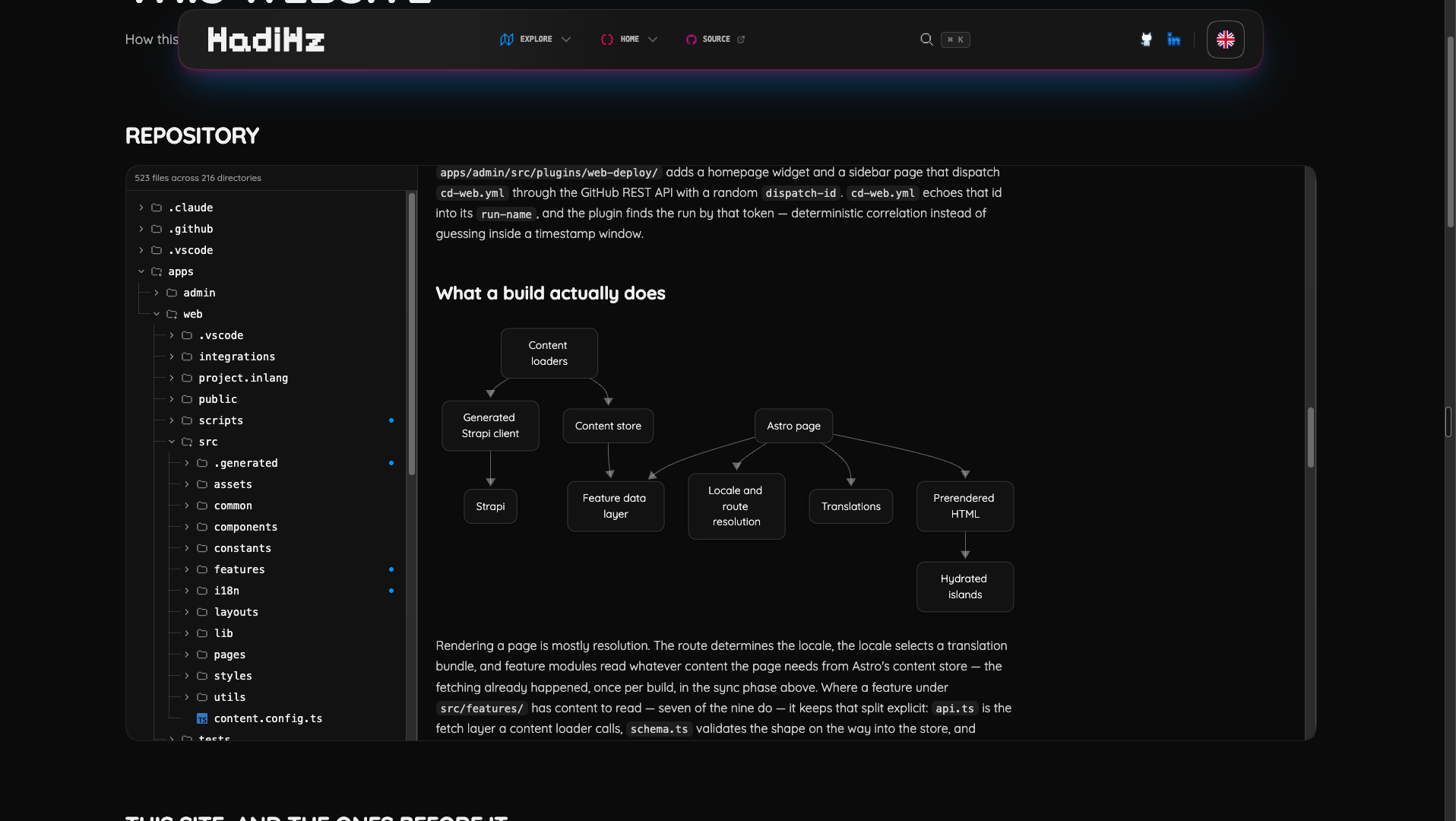
The site also documents itself. This website shows
the repository's file tree, generated from git ls-files at build time, with
notes on the paths that matter written in the CMS in all four languages. This
page is the shorter tour.
Static by construction
The Astro config sets no adapter, and that one omission shapes everything else. There is no server at request time, so every read happens at build time, in a sync phase that runs once before any page renders.
- Content edits need a rebuild, which is why the CMS has a Deploy button: a small Strapi plugin that starts the web deploy and shows its runs in the admin.
- Secrets never reach a browser, because the build is the only process that holds them. The CMS token is a server-only Astro environment variable.
- Two exceptions, both without secrets. The contact form posts to the CMS and is defended by a honeypot and a rate limiter instead of a token, and it answers the visitor by email in the language they wrote in. The optional sign-in, by email and password or with GitHub, keeps its credential in an httpOnly cookie on the CMS origin and its short-lived access token in memory, never in storage.
- Measured, not assumed. Dark mode used to flash the light palette for a
measured 532 ms before a class landed; it is now a
prefers-color-schememedia query that resolves before first paint, which deleted code instead of adding it.
Inside the web app
apps/web/src is four layers, and the direction between them is the point.
- File names are roles. Inside a feature,
repository.tsis the fetch layer a content loader calls andservice.tsreads the result back from the content store; one feature reaches another only through itsservice.ts. A file that is hard to name is usually doing two things. - No barrels, by design. A test follows every static and dynamic import
from each browser entry point and fails if one reaches
astro:contentor a server-only variable, so a server module can never slip into a bundle. - Four languages, one page directory. An in-repo Astro integration walks
src/pages/and injects a/{locale}route for every non-default locale, with translated slugs from one manifest that also drives Paraglide's URL patterns. English stays unprefixed, and a link to a renamed page is a compile error. - Search is a static file per locale, assembled at build time from projects, posts, timeline entries and tags. Open Graph images are rendered per page at build time too.
The CMS
Strapi 5 runs as its own app on its own React stack and shares nothing with the site but data.
- One generated contract.
pnpm --filter admin generatereads the schema from a running Strapi and writes a typed client into the web app. Change a content type, regenerate, and the type errors say what to fix. - Built for four languages.
strapi-plugin-ai-translate, a package in this repository, translates an entry into the other locales through an LLM from the edit view, with the prompt and model set in the admin. Its ten email templates, the contact replies among them, are written by hand. - Content that runs the site: projects, posts, the experience and education timeline, testimonials, GitHub contribution data and the file notes behind the self-documenting page.
CI/CD
Changes land on dev through pull requests, and a pull request from dev to
master ships them. Checks and deploys are separate workflows, and that one
split is what keeps both simple.
From branch to CDN
The life of a pull request
- One check job, on purpose. It used to be three jobs plus a gate, and
each paid a full install of both Astro and Strapi. One job pays it once,
while Turborepo still runs lint, typecheck and tests side by side inside it,
with
--continueso every failure shows in one run. - Prettier runs first, and the order matters. It reads only its own ignore file, so it must run before anything writes generated files into the working tree.
- The whole site is built on every pull request, because type checking never renders a page: a component that throws on a missing CMS field passes the check and fails the build. The CMS is not built there, because that would hand its production secrets to every pull request.
- CI runs on pull requests only. A pull request is checked on its merge
with the base, so the tree that lands on
masteris the tree already checked; branch protection keeps the base from moving under it. - The web deploy is never filtered. The self-documenting page is built from every tracked file in the repository, so a commit that only touches the docs still changes a published page. The CMS deploy, a 1 GB image and a restart, runs only when its paths change.
- Caching at three levels: the pnpm store, Turborepo's remote cache with signed artifacts, and Astro's build cache. Renovate opens dependency updates only once a release is a week old.
Shipping
- The CMS ships as a container to a VPS, with a key that can run only the deploy script, beside its own PostgreSQL, which is backed up every night. A failed health check puts the previous image back.
- The web deploy runs after the CMS, so a build never reads a schema the CMS doesn't serve yet. It uploads the hashed assets before the HTML that references them, invalidates CloudFront and fails unless the site answers within 40 seconds.
Built with AI agents
The repository is set up for coding agents as much as for people.
- Docs that route. A short root
AGENTS.mdpoints to a guide per app and to six skills written for this repository:feature-modules(where code goes),client-controllers(browser behaviour),design-system,output-neutral-refactor(refactors that must not change the rendered HTML),cms-annotations(keeping the file notes in step with the tree) anddraft-content. - Content drafted by an agent, published by a person.
draft-contentresearches a repository or a topic, drafts a project page or blog post in four languages and saves it to the CMS as unpublished drafts through Strapi's built-in MCP endpoint; this page was written that way and reviewed before publishing. - Design and motion skills. Sixteen of Emil Kowalski's skills on animation, interaction and polish are pinned in a lockfile.
Key Features:
- Four languages with translated URLs, right to left in Arabic, and English unprefixed
- Prerendered pages on S3 and CloudFront, with JavaScript only in islands that need it
- View transitions, dark mode with no flash, and a globe of where projects happened
- A self-documenting page: the live repository tree with notes from the CMS
- Static search and per-page Open Graph images, both generated at build time
- A contact form that answers in the visitor's language, and an optional sign-in with email or GitHub
- A Strapi admin with AI translation and a Deploy button that rebuilds the site
Tech Stack:
- Web: Astro 7, React 19, Tailwind v4, Paraglide, TypeScript, Embla, Mermaid, Shiki
- CMS: Strapi 5, PostgreSQL, Resend, OpenRouter for translation
- Infrastructure: AWS S3 and CloudFront, Docker on a VPS, nightly backups to Cloudflare R2
- Tooling: Turborepo, pnpm, ESLint, Prettier, Vitest, Renovate, GitHub Actions
By the numbers (November 2026): about 980 commits since April 2026, 151 merged pull requests, 61 test files, 15 feature modules, 19 content types and 5 GitHub Actions workflows.